

Yes, buying a second hand car is a smart choice if you want better value for money, lower depreciation loss, affordable insurance, and access to higher segment models within a limited budget. Don’t think that Should I Buy Second Hand Car ? It becomes a practical decision when the vehicle has a verified service history, reasonable kilometers driven, clear ownership documents, and no major accident damage. However, if you prefer the latest features, zero previous wear and tear, and full manufacturer warranty, a new car may suit you better. The right decision depends on your budget, driving needs, risk tolerance, and long term financial goals.

Should I buy a Second hand Or a New Car?
If you want lower upfront cost and better value for money, buy a second hand car. If you want the latest model, warranty protection, and complete peace of mind, buy a new car.
A new car starts losing value the moment it leaves the showroom. In India, most cars lose around 15 to 25 percent of their value in the first year. In contrast, a used car has already absorbed this depreciation. This means you can afford a bigger, safer, or more premium model at the same price as a new entry level car.
However, a new car offers zero usage history, full manufacturer warranty, latest safety updates, and smoother loan processing. A second hand car requires careful inspection and document Verification but can save you lakhs of rupees. If you can do this don’t think just go for Second Hand Car
Is it better to buy a used car compared to a new car?
Yes, it is better to buy a used car if your main goal is saving money and avoiding rapid depreciation.
Used cars are generally cheaper to buy, cheaper to insure, and sometimes cheaper to register depending on state rules. You can also negotiate the price more aggressively in the used market. However, maintenance costs may be slightly higher depending on the age and condition of the vehicle.
If financial stability and low EMI pressure are important to you, a used car is often the better option.
Also Read this: Best Cars Under ₹10 Lakhs in 2026. Which One Would You choose ?
Why buy a second-hand car when a new one offers more features?
You should buy a second hand car because it gives you higher segment value at a lower price, even if it may not have the newest features.
New cars offer modern infotainment systems, better mileage figures, and updated safety technology. But in the same budget, a used car may offer a larger engine, better build quality, premium interiors, and higher comfort level. For example, instead of buying a new base model hatchback, you may afford a well maintained mid size sedan or compact SUV in the used market.
For many buyers, comfort, space, and engine performance matter more than having the latest touchscreen or connected features.
Check this : Which Is the Most Value for Money Car in India ?
What is the ideal Kms run for a car to be bought second hand?
The ideal kilometers driven for a second hand car is between 30000 km and 70000 km.
A car driven less than 30000 km is usually considered lightly used but may be expensive. A car driven more than 100000 km can still be good if properly maintained, but it may require higher maintenance in the near future.
For petrol cars, 60000 to 80000 km is generally safe if service records are complete. For diesel cars, even 100000 km can be acceptable because diesel engines are built for longer runs.
Always verify the odometer reading with service records and check for tampering before making a decision.
What should be the age of a second hand car which is good to buy?
The best age for a second hand car is between 3 to 5 years.
Cars in this age group have already faced major depreciation but are still modern in design and technology. Most vehicles within 3 to 5 years are mechanically reliable if properly maintained.
Cars older than 8 to 10 years may come at a very low price but can involve higher repair costs and resale challenges. In some Indian cities, diesel vehicles older than 10 years and petrol vehicles older than 15 years face registration restrictions.
Also Check this: New vs Used Car: Which One Should You Buy
Is it a good idea to buy a used car by getting a loan in India?
Yes, it can be a good idea to buy a used car with a loan if you choose a low interest rate and keep EMI within 15 to 20 percent of your monthly income.
Used car loan interest rates are usually higher than new car loans. Down payment requirements may also be higher. However, financing a used car allows you to preserve savings and manage cash flow.
Before taking a loan, compare offers from banks and NBFCs, check processing fees, and calculate total interest outflow.
What is the process of purchasing a second hand car which has a loan over it?
To buy a second hand car with an existing loan, first ensure the seller clears the outstanding loan and obtains a No Objection Certificate from the bank.
The bank must provide loan closure letter, Form 35, and NOC. Only after loan clearance should you proceed with ownership transfer through the Regional Transport Office. The hypothecation entry must be removed from the Registration Certificate.
Never pay full amount directly to the seller without confirming loan settlement. In many cases, buyers directly pay the outstanding amount to the bank and the remaining balance to the seller.
What are the advantages and disadvantages of buying a second-hand petrol car in India?
The main advantage of buying a second hand petrol car in India is lower initial cost and lower maintenance complexity compared to diesel cars.
Petrol cars are generally smoother, quieter, and cheaper to maintain. They are suitable for city driving and low daily running. Spare parts are easily available and servicing is straightforward.
The disadvantages include slightly lower mileage compared to diesel cars and lower resale value in some segments. If you drive long distances daily, diesel may offer better fuel efficiency.
What are the things to consider when buying a second-hand car?
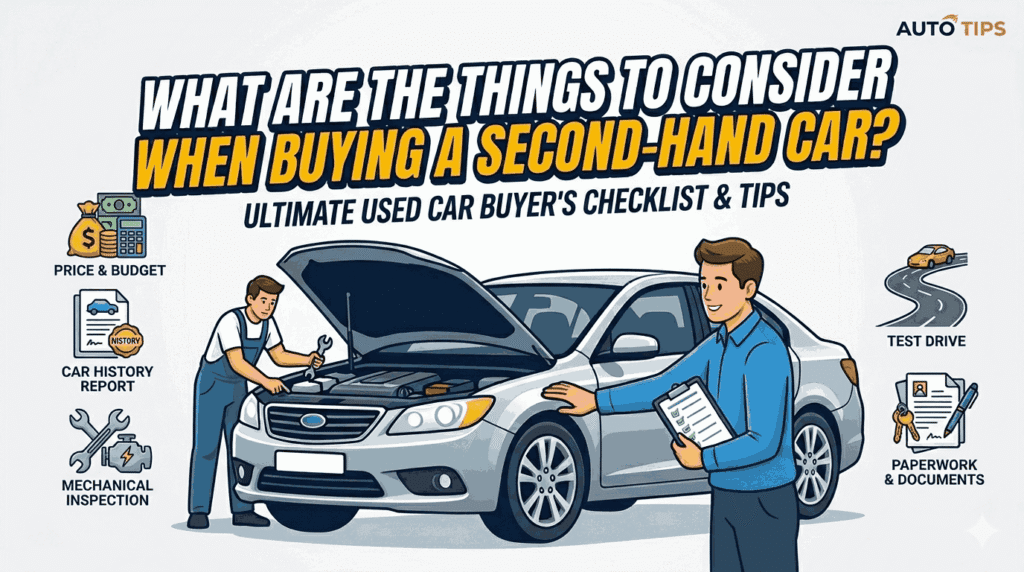
- Check Complete Service History
Always verify the full service record of the car. A properly maintained vehicle will have regular service entries from authorized service centers or trusted garages. Service history helps you understand whether oil changes, filter replacements, brake servicing, and major repairs were done on time. Missing service records can be a red flag and may indicate poor maintenance. - Verify Accident and Damage History
Ask the seller clearly if the car has been involved in any accident. Inspect the body panels carefully for repainting marks, uneven paint finish, welding marks, or mismatched colors. Check panel gaps between doors, bonnet, and boot. Uneven gaps may indicate past accident repairs. A major accidental car may create long term structural and safety issues. - Confirm Ownership Details
Check how many previous owners the car has had. Ideally, a single owner car is preferred because it is usually better maintained. Verify the name on the Registration Certificate and match it with the seller’s identity proof. Multiple ownership transfers in a short time may require deeper investigation. - Inspect RC and Legal Documents
Verify the Registration Certificate is original and valid. Check engine number and chassis number physically on the vehicle and match them with the RC. Also confirm that road tax has been paid and there are no legal disputes linked to the vehicle. Document verification protects you from future legal complications. - Check Insurance Validity and Claim History
Ensure the car has a valid insurance policy. Review past insurance claims to understand if the car has faced major damage earlier. Multiple large claims may indicate repeated accidents. Also confirm whether the policy is comprehensive or third party only. - Examine Exterior Condition
Inspect the car in daylight. Look for rust under doors, near wheel arches, and below the car body. Check tires for uneven wear, which may indicate alignment or suspension problems. Examine headlights, tail lights, and windshield for cracks or replacements. - Evaluate Engine Condition
Start the engine and listen carefully for unusual knocking or vibration sounds. The engine should start smoothly without excessive smoke from the exhaust. Blue or black smoke may indicate engine issues. Also check for oil leakage around the engine area. - Test Clutch, Gearbox, and Brakes
During a test drive, check if the clutch feels smooth and not too hard. Gear shifts should be smooth without grinding noise. Test brakes at different speeds and ensure the car stops in a straight line without vibration. Weak braking or pulling to one side may indicate brake system problems. - Inspect Suspension and Steering
Drive the car on uneven roads to check suspension performance. Excessive noise or bouncing may mean worn out suspension parts. Steering should feel stable and not loose. Any abnormal vibration at higher speeds may signal alignment or suspension issues. - Take a Proper Test Drive
Do not rely on a short drive. Test the car in city traffic as well as on highways. Check acceleration, braking response, engine performance, and overall comfort. A proper test drive reveals practical driving issues that may not be visible during static inspection. - Check Pending Challans and Liabilities
Verify if there are any pending traffic challans or unpaid penalties linked to the vehicle. This can be checked online through official transport portals. Unpaid fines will become your responsibility after ownership transfer if not cleared. - Confirm Loan or Hypothecation Status
If the car was purchased on loan, ensure the seller has cleared the loan and obtained a No Objection Certificate from the bank. The hypothecation entry must be removed from the Registration Certificate before final transfer. - Get Professional Inspection
If you are not technically confident, hire a trusted mechanic or professional inspection service. A small inspection fee can save you from large repair expenses later. Professional evaluation provides peace of mind before making the final payment. - Complete Ownership Transfer Properly
Never delay the ownership transfer process at the Regional Transport Office. Submit all required forms, insurance transfer request, and updated documents immediately. Proper ownership transfer legally protects you from future accidents, penalties, or misuse of the vehicle.
Parivahan Sewa portal for RC verification:- Official Link
Insurance Information Bureau of India:- Official Link
OBD scanner tools for car diagnostics:- Tools Link
Considering these points carefully ensures that your second hand car purchase becomes a safe, smart, and financially secure decision.
Conclusion:
If you think Should I Buy Second Hand Car ? Buying a second hand car is not just about saving money. It is about making a financially wise decision that matches your lifestyle and budget. If you carefully inspect the vehicle, verify documents, and negotiate smartly, a used car can offer excellent value and peace of mind. For first time buyers, budget conscious families, and practical drivers in India, a well maintained second hand car is often the smarter choice compared to buying new.